;how to Know if You Got All of a Tick Out
For an overview of why we want to go these pests out, go to the Tick talk page.
We are somewhat lucky in that none of the ticks we tend to see locally are large biters. Oh, they adhere well and volition stay attached to a host for a long time, simply they don't shove their mouthparts in to the point that their heads are buried. Some of the ticks ordinarily seen in the southern United states of america attach deep and are pretty hard to leave.
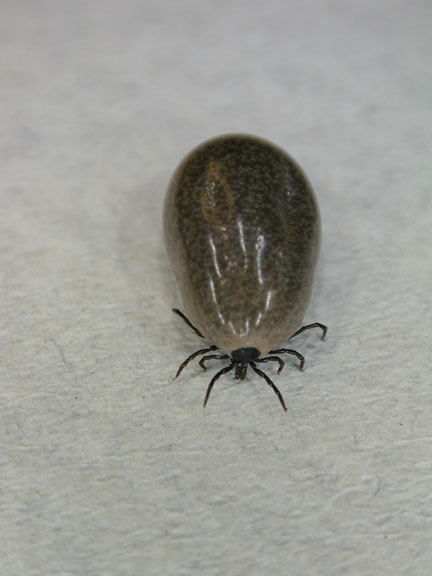
Here (left) is a picture of a small tick correct subsequently we removed it from a canis familiaris. It is a fiddling fatty considering it had fed for a while, probably a day or 2. Information technology's a proficient pic of the bones tick trunk parts - there are 8 legs, a small plate of nighttime grey armor where the thorax is, and the mouthparts in the front end. The grey body is where the stomach is and where the claret collects, engorging the tick's body.
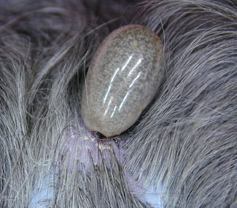
On the forepart of this tick (grey tick on a grey dog, correct) you lot can't really come across the mouthparts - they are buried in the skin. The legs are still right at the forepart by the head just are very hard to see, and the body has expanded enormously behind like a big balloon. This guy had probably been fastened for several days, enough of fourth dimension to first transmitting Lyme disease if he carried it.
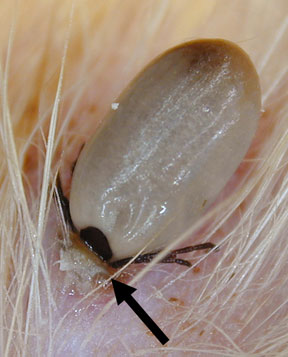
And here'due south a another tick at the trough. See how far forward the legs are? He has his confront buried in the dog's pare with the mouthparts sunk in, sucking up claret. Notice that there is some guck collecting around where he is feeding. This is some dead tissue and some inflammatory exudate acquired past his feeding.
So ... we demand to go him outta there! Here'southward how.
Notation: This method is not very masculine. Information technology involves no power tools or flames. No Vaseline, gasoline, or other combustible materials. No animals or people should be harmed in the performance of this segment.
ane. Make sure the affair you lot are trying to remove really is a tick.
Get the dog to hold notwithstanding and part the hair. Move the thing to i side with your finger and see if you can see legs where it attaches. Brand sure it'due south the correct color. Ticks tend to expect like the one of the two different ticks on this folio - normally a grayness colour or tan/brown.
If y'all accept any doubts as to what it is, see a vet. If you can't get it off, meet a vet. If information technology starts to bleed, see a vet. If your dog bites you lot, come across a doctor, and ship someone else with the domestic dog to a vet. I have had clients try to remove warts, pare tags, cysts, nipples (!) and minor pare tumors thinking they were ticks. Needless to say, their dogs were non happy.
ii. Congratulations, it's a tick! You volition need:
- a) a pair of pointy tweezers, OR b) a absurd tick removal claw (right), OR c) really long fingernails and a non-squeamish personality
- ziplock purse
- moistened cotton fiber or piece of newspaper towel
- Polysporin or other over the counter general purpose antibiotic cream
3. Part the pilus and become a good look at the tick. Figure out where it is fastened to the animal.
Of import note earlier we go any farther: Do not hang onto the tick by the torso; you will make it regurgitate into your canis familiaris. Y'all could also flare-up the tick, which is but gross and non particularly helpful to the situation, though somewhat dramatic and cool if at that place are teenagers effectually. Don't squeeze the tick at all if you tin assist it.
4. Slide the claw of the tick remover under the tick. The concept is simply similar using the claw of a hammer to remove a nail from a piece of wood. Go the remover claw snugged correct up under the tick, and then the tick is upwards in the slot as far every bit possible. If you are using tweezers, clasp them almost closed and put the tips under the tick between the head and the skin. If you lot want to apply your fingernails, be my guest. Same concept.
v. Using steady, house pressure pull the tick directly up and away from the animal. You may want to hold the peel down on either side, every bit it volition tend to tent upwardly and rising with the tick. These picayune guys are really stuck in there, and so you can't be also wimpy. You lot don't desire to interruption the tick past pulling likewise hard, but yous don't want to take to take 52 tries to go it out, either; your dog will non love you anymore. There may be a trigger-happy awareness as it lets go; this is fine and won't injure the dog.
half-dozen. Practice not fling the tick across the room in cloy. Information technology is still alive and could theoretically reattach to the dog, the cat, or your visiting mother in law. Instead, calmly accept the tick and place it in your pre-prepared ziplock purse. Brand certain there is some air in the bag with the tick. Put the moistened cotton fiber in the bag as well. Make sure the cotton isn't soaking wet; squeeze it out and so no water drips off. Information technology volition provide something for the tick to drink while yous have it in captivity.
7. Place the tick-in-a-bag in the refrigerator. Keep it in that location until yous can become it to your veterinarian and have it sent off for Borrelia testing. The tick volition live quite happily in the refrigerator for a few weeks if demand be. I am not certain why you might desire to exercise this, though. Just bring it in to us.
8. Y'all may disinfect the site with a footling lather and warm water. Rinse well. If yous desire to utilise alcohol to the site: don't! It volition really injure! Peroxide won't sting as much merely isn't particularly effective. Soap and h2o will practise the trick.
9. Find the spot on the dog where the tick was fastened and apply a niggling Polysporin. Ticks set up a pretty big inflammatory response. It is normal to see a ring of pinkish or blood-red where it was attached, and a scab. The dog volition usually lose hair around the area equally well. This is normal as long as there is no discomfort and yous are not seeing a lot of pus in the area.
Nosotros sometimes refer to this every bit a "tick granuloma". This localized swelling and thickening can take several weeks to resolve. As long as at that place is no pus and things seem to be getting gradually better rather than worse, things are fine.
If your dog seems itchy at the site, get ahead and apply a trivial Caladryl ointment or whatever non-stinging stuff yous normally utilise for mosquito bites on yourself. Exist a piddling cautious that he doesn't lick it off.
10. If y'all can stand up it, cheque out the tick. If information technology is live and waving its legs, yous removed the whole affair and didn't go out mouthparts or head behind. If information technology is dead and not waving, your dog is yet going to be OK. The remaining mouthparts will not:
- couch into the encephalon
- cause seizures
- crusade distemper
- cause rabies
- increment the risk of Borrelia manual
They will fester a piffling and might form a localized infection. Watch for this; information technology might exist worth a visit to the vet.
Source: https://www.vet.bc.ca/remove-ticks.pml
0 Response to ";how to Know if You Got All of a Tick Out"
Post a Comment